The Manager Community Development will coordinate the implementation, monitoring and annual review of the Multicultural Inclusion Plan 2026–2030 to ensure it remains responsive to changing community needs and aligned with Council’s strategic priorities.
The annual review will:
• monitor progress against the actions contained within the Plan
• review priorities in consultation with relevant Council business units
• analyse demographic trends, community feedback and advice from the Multicultural Advisory Committee to identify emerging issues and opportunities
• monitor participation trends and service outcomes to identify barriers and gaps in access
• prepare an annual progress report for consideration by the Executive, the Multicultural Advisory Committee and Council, and
• inform continuous improvement of Council policies, programs, and service delivery.
Council will develop and maintain an Outcome Measurement Framework to support consistent evaluation of the Plan by:
• monitoring progress against strategic actions
• embedding equity and lived experience into evaluation
• supporting evidence-based planning and continuous improvement
• strengthening accountability and transparency, and
• informing future reviews of the Multicultural Inclusion Plan.
Reporting cycle
• Annual Review: Progress reported to the Multicultural Advisory Committee and Council.
• Mid-Term Evaluation (2028): Evaluation of implementation progress and refinement of priorities where required.
• Public Reporting: Outcomes included through Council’s Integrated Planning and Reporting framework.
CALD
Culturally and Linguistically Diverse. Refers to individuals or communities who identify with cultural heritages and/or speak languages other than English.
Community Strategic Plan (CSP)
Council’s long-term plan that outlines the community’s vision and priorities over a 10-year period. All other Council plans align with the Community Strategic Plan.
Cross-Cultural Communication Training:
Education and development activities that build staff capacity to communicate effectively and respectfully with people from diverse cultural backgrounds. This training focuses on increasing cultural awareness, reducing unconscious bias, and developing verbal and non-verbal communication skills in intercultural settings. It supports frontline staff, leaders and customer-facing teams in understanding cultural norms, avoiding miscommunication, and improving service delivery to multicultural communities.
Cultural Competency:
The ability to understand, respect, and effectively interact with people from diverse cultural backgrounds. It involves awareness of one’s own cultural worldview, knowledge of different cultural practices and worldviews, and the skills to communicate and work inclusively.
Delivery Program and Operational Plan (DPOP):
The Delivery Program sets out the work Council will do over four years to deliver the Community Strategic Plan. The Operational Plan breaks this down into actions and budgets for each year.
Inclusive Language Guide:
A written resource that provides staff with guidance on using respectful, accurate and culturally sensitive language in all Council communications. The guide covers inclusive terminology relating to culture, race, gender, disability and other diversity markers. It encourages strengths-based, people-first language and helps staff avoid stereotypes or exclusionary phrases. It is intended for anyone producing written content such as reports, media, signage, policies, or public information. See also: Multilingual Communication Practice Guide.
Interpreter Services (TIS):
The Translating and Interpreting Service (TIS National) provides access to interpreters in over 150 languages for people who have difficulty communicating in English.
Multiculturalism:
The coexistence of diverse cultures, where cultural differences are accepted and valued as part of a shared society.
Multilingual Communication Practice Guide:
A practical tool that outlines how and when to use interpreters, translated materials, bilingual staff and plain English to communicate effectively with culturally and linguistically diverse (CALD) communities. This guide helps staff plan accessible communication strategies by matching the method (e.g., interpreter vs translated document) to the situation. It includes advice on identifying key community languages, working with translation services, and ensuring equitable access to information across all platforms.
See also: Inclusive Language Guide.
Plain English:
A style of writing that is clear and straightforward, avoiding jargon or complex terms. It ensures information is easily understood by a wide audience, including those with limited English proficiency.
The Multicultural Inclusion Plan supports and aligns with Ku-ring-gai Council’s integrated planning framework, including the Community Strategic Plan 2035, Delivery Program 2026–2030 and Operational Plan 2026–2030*. These documents outline Council’s long-term vision and short- to medium-term actions to achieve a connected, inclusive and resilient community.
This appendix identifies how the goals and actions of the Multicultural Inclusion Plan contribute to:
• Community Strategic Plan, long-term objectives related to social equity, inclusion, and community wellbeing.
• Delivery Program, term achievements that address access, engagement and cultural participation; and
• Operational Plan, annual tasks that support implementation of inclusive services, programs and communications.
The Multicultural Inclusion Plan is intended to contribute to the development of future strategic and operational plans, ensuring that cultural inclusion remains embedded across Council’s planning processes and reflects the evolving needs and priorities of our diverse community.
*Refer to Integrated planning and reporting on Council’s website for updated plans.
|
Community Strategic Plan Long Term Objective |
Delivery Program Term Achievement |
Operational Plan Task |
|
A2: Provide, upgrade and maintain open space, recreation and sporting facilities to meet the needs of current and future user groups and a growing population. |
A2.1: A program is implemented to provide, improve and maintain open space, recreation and sporting facilities including multi-use facilities. |
A2.1.3: Actively engage with sporting organisations and clubs, user groups and residents during the preparation of plans, policies and strategies for sport and recreation. |
|
|
A2.2: Partnerships with community groups and organisations assist to optimise the availability and use of open space, recreation and sporting facilities. |
A2.2.1: Engage with community partners to improve sporting, leisure and recreational facilities through partnerships, grant funding and other external funding opportunities. |
|
C1: Work with partners to promote a diverse and inclusive community that cares and provides for all residents |
C1.1: Access to services and programs is equitable for all community members. |
C1.1.4: Strengthen partnerships to support and advocate for vulnerable groups while tailoring services and programs to meet their needs. |
|
|
C1.4: Partnerships assist to promote access to services, active lifestyles and programs that support the health and wellbeing of older residents. |
C1.4.1: Support and resource community organisations, including governance, training and management assistance. |
|
C2: Support communities that understand, value and accept each other and embrace our evolving cultural identities. |
C2.1: Culturally appropriate services and programs are developed and delivered to meet the needs of diverse communities. |
C2.1.1: Deliver culturally appropriate services and programs that cater to diverse communities. |
|
|
|
C2.1.2: Provide professional advice and administrative support for the Multicultural Advisory Committee. |
|
|
|
C2.1.3: Develop and implement a Multicultural Inclusion Plan to foster diversity and community cohesion. |
|
|
|
C2.1.4: Implement a civic engagement program for new residents to increase local government understanding. |
|
|
|
C2.1.5: Deliver cultural and community related festivals and events that celebrate our diversity. |
|
C3: Facilitate and deliver community risk and safety programs that enhance neighbourhood connections and community responses to emergency events. |
C3.2: Community safety through crime prevention initiatives, events and partnerships with local law enforcement is enhanced. Lead: Manager Community Development. |
C3.2.1: Facilitate, resource and promote collaborative approaches to community safety that prevent anti-social behaviour and support local crime prevention initiatives. |
|
|
C3.3: Emergency Management Plans are developed and implemented in partnership with emergency service agencies and key stakeholders. |
C3.3.1: Communicate emergency management plans to residents and the community to improve their preparedness for emergency events. |
|
C4: Cultivate lifelong learning, foster local arts and creativity and celebrate our cultural diversity. |
C4.1: Enhanced library services act as hub for lifelong learning and social connections. |
C4.1.1: Develop and curate diverse information collections, including local studies and electronic resources, that reflect cultural diversity and local community pride. |
|
|
|
C4.1.2: Deliver accessible and inclusive library services, including information and lending, aligned with social justice principles. |
|
|
|
C4.1.3: Provide and promote cultural, creative, literacy and informational programs that encourage lifelong learning and community engagement. |
|
|
C4.2: The creative arts sector and local artists are provided opportunities to participate in Council’s programs and events that showcase our diverse and talented arts sector. |
C4.2.2: Provide opportunities for the local arts and cultural community through the annual Arts and Culture Festival. |
|
|
|
C4.2.3: Deliver community education programs, cultural festivals and events that celebrate cultural diversity. |
|
L1: Provide strong and ethical civic leadership to ensure good governance and build and maintain trust and confidence within the community. |
L1.1: The Community Strategic Plan drives delivery of community priorities through effective strategic planning, prioritisation, advocacy, partnerships and reporting to the community on performance. |
L1.1.2: Update reports and supporting system to deliver clear and comprehensive reporting to councillors and the community on performance and delivery. |
|
|
|
L1.1.4: Engage with government agencies, community groups and organisations in the development and implementation of plans and policies. |
|
|
L1.2: Council's governance framework supports probity, transparency, compliance with legislative requirements and a culture of ethical conduct and informed decision-making. |
L1.2.6: Prepare and deliver a professional development program for Councillors to ensure they are aware of their responsibilities and have the skills necessary to perform their roles. |
|
L3: Deliver services effectively and efficiently on the basis of equity, community priorities and best value within available resources. |
L3.1: Workforce capacity is strengthened through skill development, continuous learning, and the attraction and retention of talented, engaged employees. |
L3.1.1: Effectively deliver learning and development strategies and programs in line with identified priorities and the objectives of Council’s adopted Workforce Management Strategy. |
|
L4: Provide a high-quality customer experience that meets expectations. |
L4.1: Best practice customer service is provided to the community through benchmarking, community feedback and complaints management. |
L4.1.1: Improve the delivery of customer service through regular training, benchmarking and feedback. |
|
L5: Provide high quality community engagement and communications to enhance collaboration, participation and decision-making. |
L5.1: Innovative and effective community engagement increases opportunities for participation by all members of the community. |
L5.1.2: Convene regular meetings of the community engagement champions to report, plan and improve community engagement delivery. |
|
|
|
L5.1.3: Continue to enhance engagement with people with disabilities, culturally and linguistically diverse groups, LGBTQI+ and young people. |
|
L5.2: Council’s website and other communication channels provide a reputable source of information on policies, projects and programs. |
L5.2.1: A wide range of communication channels are used to promote Council services to agreed corporate standards. |
L5.2.2: Council services, programs, policies and achievements are promoted across all media and outcomes are monitored. |
|
|
|
L5.2.5: Promote Council festivals and events using Council communication channels. |
Diversity and inclusion extend beyond culture, ethnicity, language and religion. They also encompass equitable access, meaningful participation, and freedom from discrimination for people with disability, older adults, and members of the LGBTIQ+ community. Council’s ongoing commitment to reconciliation and closing the gap with First Nations peoples is also central to this work.
At its core, diversity and inclusion are about removing social barriers and upholding the human rights and dignity of all people.
This Plan forms part of a broader suite of strategies that guide Council’s inclusive approach. It should be read in conjunction with the following documents to provide a comprehensive and integrated understanding of how diversity and inclusion are embedded across the Ku-ring-gai community.
a. Community Strategic Plan
b. Delivery Program and Operational Plan
c. Equal Employment Opportunity Management Plan
d. Equity and Diversity Policy
e. Community Engagement Strategy
f. Access and Disability Inclusion Plan
h. Community Needs Analysis
Ku-ring-gai Council acknowledges the Traditional Custodians of the land and waters, and pays respect to Elders past, present and emerging.

Ku-ring-gai is a proud, welcoming and culturally diverse community. The many cultures, languages and traditions represented across our local government area enrich our community, strengthen social connections and contribute to the unique character of Ku-ring-gai.
As Mayor, I am pleased to present Council’s Multicultural Inclusion Plan 2026–2030, which provides a practical framework to strengthen inclusion, belonging and respect for everyone who calls Ku-ring-gai home. This Plan reflects Council’s commitment to fostering a community where every person feels seen, valued and able to participate fully in community life.
Cultural diversity is one of Ku-ring-gai’s greatest strengths. Whether you have newly arrived, have lived here for many years or have deep local connections, your contribution helps shape our community. Through this Plan, Council will continue to work in partnership with residents, community organisations, businesses and government agencies to promote understanding, celebrate diversity and create opportunities for meaningful participation.
Thank you to everyone who contributed their ideas, insights and lived experience to this Plan. Together, we are shaping a more inclusive, connected and culturally vibrant Ku-ring-gai.
Councillor Kim Wheatley
Mayor
Ku-ring-gai is a culturally diverse local government area, with more than 42% of residents born overseas and one in three households speaking a language other than English at home. This diversity brings a wealth of knowledge, traditions, languages and perspectives that enrich our community, strengthen our local economy, enhance civic life, and deepen our global connections.
These characteristics shape community needs, expectations and participation and are an important consideration in Council’s planning, service delivery and decision making.
Ku-ring-gai is home to people from a broad range of ancestries and cultural identities, contributing to a rich and evolving community profile that informs Council’s approach to inclusive community engagement, planning and service delivery.
The Importance of Inclusion
To fully realise the benefits of cultural diversity, it must be supported by an environment where everyone feels welcomed, respected and included.
Inclusion enables people of all backgrounds to participate fully in community life, experience a genuine sense of belonging, and contribute meaningfully to community life while maintaining the freedom to express and celebrate their cultural identity.
Creating an inclusive community requires a shared commitment across government, business, education, community organisations and residents. Through collaboration, understanding and mutual respect, we strengthen social cohesion, build community resilience and create a more connected and welcoming Ku-ring-gai for the benefit of all.
Snapshot of cultural diversity in Ku-ring-gai
Ku-ring-gai is a culturally diverse and internationally connected community.
According to the 2021 Australian Bureau of Statistics Census:
• 52,849 residents (42.6%) born overseas.
• More than one-third of residents (41,469 people) speak a language other than English at home.
• There are 66 community languages spoken across the local government area.
The most commonly spoken community languages are Mandarin, Cantonese, Korean, Farsi, and Japanese. Ancestry data further highlights this diversity, with residents identifying a broad range of cultural backgrounds. The most commonly identified ancestries are English, Chinese and Australian, followed by Irish, Scottish, Indian, Korean, German, Italian, and South African.
Compared with Greater Sydney, Ku-ring-gai shows a higher proportion of residents with English and Chinese ancestry, alongside a similar representation of many European ancestries, reflecting both long-established communities and more recent migration trends.
While these statistics provide valuable insight into our community, they do not capture the full picture. Many second and third generation Australians continue to identify strongly with their cultural heritage, language and traditions, demonstrating that cultural identity extends beyond country of birth or language spoken at home.
• It is important to be mindful that these statistics only provide a part-picture. They do not fully capture second or third generation migrants who may still strongly identify with, and actively maintain, their cultural heritage, language and traditions.
Birthplace
In 2021, 52,849 residents (42.6%) were born overseas, compared with 38,775 residents (35.5%) in 2011.This reflects the continuing growth in Ku-ring-gai’s cultural diversity over the past decade.
The largest overseas-born population groups are:
• China – 12,911 residents
• United Kingdom – 7,085 residents
• South Africa – 3,740 residents
• Hong Kong – 3,602 residents
• India – 2,633 residents
• South Korea – 2,531 residents
• New Zealand – 2,052 residents
• Malaysia – 1,529 residents
• Iran – 1,504 residents
This diversity contributes significantly to the social, cultural and economic life of Ku-ring-gai and highlights the importance of ensuring Council's services, communication and engagement remain inclusive and responsive.
English Proficiency and Linguistic Diversity
Ku-ring-gai is home to a highly multilingual community. While most residents who speak a language other than English at home also report speaking English well or very well, the number of residents with limited English proficiency has increased over the past decade. In 2021, 5,858 residents (4.7 per cent) reported speaking English "not well" or "not at all", compared with 2,870 residents (2.6 per cent) in 2011. This highlights the importance of ensuring Council information, communication and services remain accessible to all members of the community.
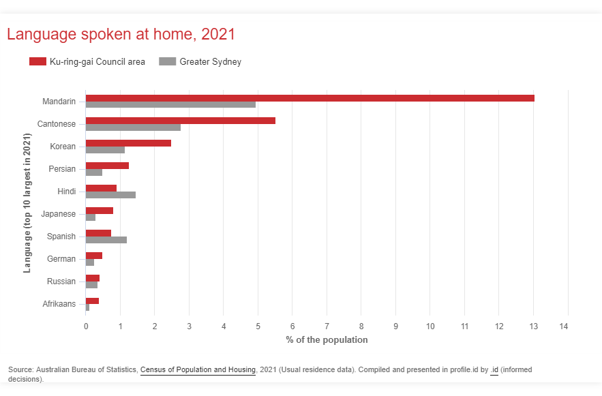
Language diversity continues to grow across Ku-ring-gai. In 2021, 33.4 per cent of residents spoke a language other than English at home, an increase from 21.0 per cent in 2011. Over the same period, the number of residents speaking a language other than English at home increased by 18,517 people, reflecting the changing demographic profile of the local government area.
Chinese languages are the most widely spoken community languages, with 23,059 residents speaking Mandarin or Cantonese at home. Other commonly spoken languages include Korean (3,100), Persian (Farsi) (1,578), Hindi (1,134) and Japanese (1,010). Together, these languages reflect the rich cultural diversity of Ku-ring-gai and reinforce the importance of culturally responsive communication, community engagement and service delivery.
The increasing linguistic diversity of Ku-ring-gai presents opportunities to strengthen community participation, improve access to Council services and ensure information is communicated in ways that are inclusive, accessible and responsive to the needs of residents from diverse cultural and linguistic backgrounds.
|
Language spoken at home - Summary |
|||||||
|
Ku-ring-gai Council area - Total persons (Usual residence) |
2021 |
2011 |
Change |
||||
|
Language summary |
Number |
% |
Greater Sydney % |
Number |
% |
Greater Sydney % |
2011 to 2021 |
|
Speaks English only |
79,470 |
64.1 |
57.3 |
82,608 |
75.6 |
62.2 |
-3,138 |
|
Non-English total |
41,679 |
33.4 |
37.4 |
22,952 |
21.0 |
32.4 |
+18,517 |
|
Not stated |
3,137 |
2.5 |
5.3 |
3,739 |
3.4 |
5.4 |
-602 |
|
Total Population |
124,286 |
100.0 |
100.0 |
109,299 |
100.0 |
100.0 |
+14,777 |
Religious Affiliation in Ku-ring-gai
Religion is an important aspect of cultural identity for many residents and contributes to the rich diversity of the Ku-ring-gai community.
According to the 2021 Census, the largest religious affiliation is Western (Roman) Catholic, representing 16.5% of the population, closely followed by Anglican at 15.2%. A significant proportion of residents (41.2%) reported having no religious affiliation, while 4.1% chose not to state a religion.
Other religious affiliations represented in the community include:
• Uniting Church – 3.7%
• Buddhism – 3.1%
• Hinduism – 2.4%
• Judaism – 2.3%
• Islam – 1.0%
This diversity of faiths and beliefs reinforces the importance of inclusive communication, culturally responsive service delivery, and consideration of religious and cultural observances when planning Council services, programs, events and engagement activities.
For further demographic information, refer to Council’s Community Profile available at: https://profile.id.com.au/ku-ring-gai
Cultural diversity is a defining characteristic of both Ku-ring-gai and contemporary Australian society. The community is enriched by a broad range of cultural, linguistic and religious backgrounds that contribute to its identify, social cohesion and community life.
As the community continues to diversify, Council recognises that some residents may experience barriers to accessing information, services and opportunities to participate in community life. Creating an inclusive community requires more than recognising diversity; it requires removing barriers and ensuring all people can participate equitably.
Inclusion is reflected in the systems, practices and environments that enable equitable access to information, services, facilities and decision-making, while fostering a strong sense of belonging for all members of the community.
Council’s commitment to our multicultural community
Our Commitment
Ku-ring-gai Council is committed to fostering a welcoming and inclusive and connected community where diversity is recognised as a strength and everyone has the opportunity to participate fully in community life.
Council values the contributions of people from all cultural, linguistic and religious backgrounds and is committed to supporting equitable participation in civic, cultural, social and economic life.
Council does not tolerate racism, discrimination or exclusion in any form and recognises its responsibility to identify and address barriers to participation, promote equity and create opportunities for inclusion.
Through leadership, partnerships and culturally responsive service delivery, Council is committed to strengthening social cohesion, promoting mutual understanding and ensuring Ku-ring-gai remains a safe, respectful and inclusive community for all.
Principles of Multiculturalism
Council’s commitment to multicultural inclusion is guided by the principles of the Multicultural NSW Act 2000 (amended 2014) which recognise cultural diversity as a strength and promote equitable participation across the community.
These principles affirm that:
• the people of New South Wales come from diverse linguistic, religious, racial and ethnic backgrounds, and are free to maintain and celebrate their cultural heritage,
• the shared values of democracy, the rule of law and equality under the law unite all people, regardless of background,
• all individuals should have the greatest possible opportunity to participate in the social, cultural, economic and political life of the State,
• mutual respect and recognition of cultural, linguistic and religious diversity should be promoted, while recognising English as the common language.
• Government programs and services should be delivered in ways that are accessible, inclusive and responsive to the diversity of the community and population.
• the cultural and linguistic diversity of New South Wales is a valuable asset that should be recognised, preserved and celebrated.
Purpose and Strategic Intent
The Multicultural Inclusion Plan 2026–2030 establishes Council’s strategic framework for strengthening multicultural inclusion across the community.
The Plan provides a coordinated approach to embedding multicultural inclusion across Council’s planning, service delivery, communication, workforce capability and community engagement. It supports equitable access to services, encourages meaningful participation, strengthens community belonging and provides a framework for collaboration between Council, its partners and the community.
The Plan responds to Ku-ring-gai’s evolving demographic profile by recognising the growing diversity of the community and embedding culturally responsive practices across Council’s operations.
Council’s commitment to social inclusion is supported by the Local Government Act 1993 (NSW) and the Integrated Planning and Reporting (IP&R) Framework, which require councils to understand community needs, promote equitable access to services, and support meaningful participation in local decision-making.
These principles are reflected throughout Council’s integrated planning framework, including the Community Strategic Plan 2035, Delivery Program 2026–2030 and Operational Plan.
The Plan is underpinned by four key principles:
• Equity – ensuring fair and equitable access to services, programs, facilities and opportunities.
• Access – reducing barriers so all members of the community can obtain information, services and support.
• Participation – enabling meaningful involvement in community life and Council decision-making.
• Rights – supporting the right of every person to participate in community life free from discrimination and barriers to inclusion.
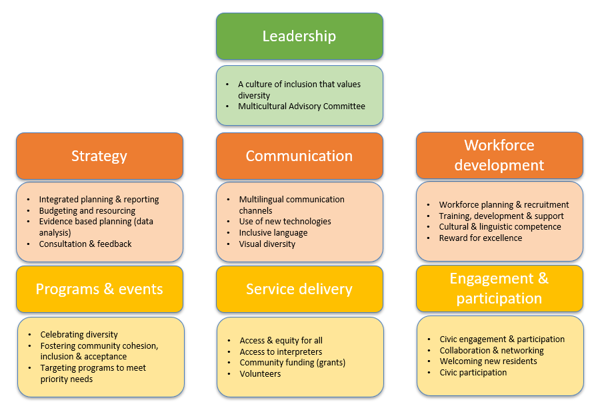
Council is committed to leadership in advancing diversity and inclusion. The Plan is structured around seven strategic goals:
• Leadership
• Strategy
• Communication
• Workforce Development
• Programs and Events
• Service Delivery
• Community Engagement and Participation
Together, these goals translate Council’s commitment into practical actions that strengthen organisational capability and support an inclusive, welcoming and connected community.
The Multicultural Inclusion Plan aligns with Council’s broader planning framework, while supporting NSW Government priorities relating to multi-culturalism, social cohesion, anti-racism and inclusive service delivery.
The Multicultural Inclusion Plan has been developed by Ku-ring-gai Council in collaboration with community members, local organisations, Council staff and the Ku-ring-gai Multicultural Advisory Committee.
Development of the Plan was informed by demographic analysis, place-based research and a review of the social, economic and cultural characteristics of the Ku-ring-gai community. A strategic context review was undertaken to ensure alignment with relevant Commonwealth, State and local legislation, policies and strategic directions. Contemporary and international examples were also considered to identify approaches that strengthen multicultural inclusion, community participation and social cohesion.
The Plan also draws on previous community engagement undertaken by Council, including consultation that informed the Community Strategic Plan 2035, community satisfaction research and other relevant engagement activities. These insights have helped shape a practical and evidence-based framework that responds to the current and emerging needs of Ku-ring-gai's diverse community.
Overview

Council provides visible leadership by embedding multicultural inclusion across governance, organisational culture and decision making, fostering an inclusive organisation and a connected community.
|
LEADERSHIP |
Timeline |
Responsibility |
|
A culture of inclusion that values diversity |
||
|
1.1 Demonstrate culturally inclusive leadership by modelling inclusive workplace practises and embedding the Principles of Multiculturalism across Council. |
Ongoing |
Elected Council |
|
1.2 Support, attend and promote multicultural events, celebrations and initiatives that are significant to Ku-ring-gai’s diverse communities. |
Ongoing |
Elected Council |
|
1.3 Recognise and celebrate staff who demonstrate cultural competence and inclusive leadership. |
2027 |
Managers People and Culture |
|
1.4 Advocate for and participate in local, regional and sector forums that strengthen inclusion and create opportunities for culturally diverse communities. |
Ongoing |
Elected Council |
|
1.5 Embed cultural competence within Council’s leadership development programs. |
2026 |
General Manager and Directors People and Culture |
|
1.6 Engage with community networks and stakeholders to identify opportunities to recognise and celebrate cultural diversity through civic ceremonies and public events. |
Ongoing |
Visitor Experience and Events Community Development |
|
1.7 Support the ongoing competence development of Councillors and Executive leaders through professional development, training and leadership forums. |
Ongoing |
Mayor and Councillors |
|
1.8 Deliver ongoing anti-racism training for Councillors, leaders and staff to strengthen inclusive leadership, build understanding of racism, and support the prevention of discrimination across Council and the community. |
Ongoing |
Mayor and Councillors |
|
1.9 Resource and support the Multicultural Advisory Committee to provide advice and guide implementation of the Multicultural Inclusion Plan. |
Ongoing |
Community Development |
Council’s planning, policies and decision making are informed by evidence, community insight and the principles of multicultural inclusion.
|
STRATEGY |
Timeline |
Responsibility |
|
Integrated planning and reporting |
||
|
2.1 Embed multicultural inclusion, equity, social justice and anti-racism principles across Council’s strategic and operational planning framework. |
Ongoing |
General Manager and Directors Governance and Corporate Strategy |
|
2.2 Incorporate the Principles of Multiculturalism and contemporary cultural diversity data into future reviews of Council’s Integrated Planning and Reporting (IP&R) framework, including the Community Strategic Plan, Delivery Program and Operational Plan. |
2029 |
Governance and Corporate Strategy |
|
2.3 Embed multicultural inclusion into Council’s community engagement framework to ensure culturally and linguistically diverse communities are appropriately identified, engaged and represented in major projects, policies and services. |
2027 |
General Manager and Directors |
|
2.4 Monitor and report on annually the implementation and outcomes of the Multicultural Inclusion Plan. |
Ongoing |
Community Development |
|
Budgeting and resourcing |
||
|
2.5 Identify and pursue external funding sources to support multicultural programs, events and activities. |
Ongoing |
Visitor Experience and Events Community Development |
|
Evidence-based planning |
||
|
2.6 Build staff capability in the use of Council’s Community Profile tool and demographic data to support evidence-based planning and decision making. |
Ongoing |
Community Development |
Council communicates in ways that are clear, inclusive and accessible, ensuring people from culturally and linguistically diverse backgrounds can access information, services and opportunities to participate in community life.
|
COMMUNICATION |
Timeline |
Responsibility |
|
Inclusive information access |
||
|
3.1 Develop a Multilingual Communication Practice Guide that provides practical guidance on the appropriate use of interpreters, translated materials, bilingual staff, and plain English. |
2026 |
Community Development |
|
3.2 Support staff with bilingual and community language skills to participate in an approved Community Language and Signing Work program, recognising and appropriately utilising these skills to strengthen communication, customer service and community engagement. |
Ongoing |
People and Culture |
|
3.3 Ensure interpreter service information is prominently displayed at customer service touchpoints and key community facilities in priority community languages identified through local demographic data. |
2026 |
Community Development |
|
3.4 Promote Council services through multilingual channels including translated materials, digital platforms, bilingual staff, interpreter services, and multicultural media, where there is demonstrated community need. |
Ongoing |
All Departments |
|
3.5 Develop accessible complaints and feedback mechanisms that enable community members to provide feedback and report service issues in their preferred language, with insights used to identify trends and inform continuous service improvement. |
2028 |
Corporate Communications |
|
Use of technology |
||
|
3.6 Improve the accessibility of Council’s website and public information by ensuring key content, applications and forms are written in plain English and are available in accessible, translation-enabled digital formats where appropriate. |
2029 |
Corporate Communications |
|
3.7 Engage with multicultural communities, organisations and cultural groups to understand preferred communication channels, and use these insights to inform future multicultural communication and engagement approaches. |
Ongoing |
Corporate Communications Community Development |
|
3.8 Ensure Council-developed digital applications incorporate plain English, accessible design principles and features that support translation into community languages where appropriate. |
2028 |
Corporate Communications |
|
Inclusive language and imagery |
||
|
3.9 Develop an Inclusive Language Guide to support the consistent use of respectful, inclusive and culturally responsive language across Council’s communications. |
2027 |
Community Development |
|
3.10 Use imagery, graphics and promotional materials that reflect the cultural, linguistic, and demographic diversity of the Ku-ring-gai community across Council communications and publications. |
Ongoing |
Corporate Communications |
Council develops a culturally, inclusive and diverse workforce that delivers respectful and responsive services to the community.
|
WORKFORCE DEVELOPMENT |
Timeline |
Responsibility |
|
Recruitment and retention |
||
|
4.1 Implement priority actions from Council’s EEO Management Plan that strengthen diversity, equity and inclusion across the organisation. |
Ongoing |
People and Culture |
|
4.2 Implement initiatives within the Workforce Management Strategy that strengthen workforce diversity, inclusion and cultural capability of the Organisation. |
Ongoing |
People and Culture |
|
4.3 Review Council’s Equity and Diversity Policy, to ensure ongoing alignment with legislation and contemporary best practice. |
2027 |
People and Culture |
|
4.4 Collect and analyse workforce demographic data on a biennial basis to monitor workforce diversity as part of the employee opinion survey process. |
Ongoing |
People and Culture |
|
4.5 Review recruitment and selection practices to encourage applications from people with diverse cultural and linguistic backgrounds. |
Ongoing |
People and Culture |
|
4.6 Pursue external funding opportunities that strengthen Council’s multicultural capability and capacity to engage with culturally and linguistically diverse communities. |
Ongoing |
General Manager and Directors |
|
4.7 Ensure that recruitment and selection processes comply with Equal Employment Opportunity (EEO) principles and Council’s Workforce Management Strategy. |
Ongoing |
People and Culture |
|
Training and support |
||
|
4.8 Incorporate access, equity, and anti-discrimination awareness into Council’s staff induction program. |
Ongoing |
People and Culture |
|
4.9 Deliver ongoing diversity, Equal Employment Opportunity and anti-racism training to strengthen an inclusive workplace culture. |
Ongoing |
People and Culture |
|
4.10 Provide targeted cross-cultural communication training and practical resources for employees in community-facing roles to strengthen culturally responsive customer service and community engagement. |
2028 |
People and Culture |
|
4.11 Identify, support and appropriately recognise employees with bilingual and community language skills to strengthen inclusive communication, customer service and community engagement, and recognise eligible staff through the Community Language and Signing Work allowance (clause 17(xii) of the Local Government State Award 2023). |
Ongoing |
People and Culture |
Council delivers programs and events that celebrate cultural diversity, strengthen social cohesion and encourage participation across the community.
|
PROGRAMS AND EVENTS |
Timeline |
Responsibility |
|
Celebrating diversity |
||
|
5.1 Partner with the community to deliver and support multicultural programs, events and celebrations that recognise cultural heritage, strengthen community connections and promote inclusion. |
Ongoing |
Visitor Experience and Events Community Development |
|
5.2 Develop and maintain a calendar of culturally and religiously significant events and celebrations to promote staff awareness and support inclusive planning across Council. |
2026 |
Community Development Visitor Experience and Events People and Culture |
|
5.3 Co-design multicultural events and celebrations in collaboration with the Multicultural Advisory Committee and identified community representatives to ensure they are relevant, inclusive and responsive to community interest. |
Ongoing |
Visitor Experience and Events Community Development |
|
Promote community cohesion and belonging |
||
|
5.4 Embed culturally inclusive event planning principles into Council’s Engagement and Events policies to ensure Council events reflect the cultural and linguistic diversity of the Ku-ring-gai community. |
Ongoing |
Visitor Experience and Events Community Development |
|
5.5 Incorporate messages that promote inclusion, challenge racism, and celebrate cultural diversity across Council-supported cultural events and initiatives. |
Ongoing |
Visitor Experience and Events Community Development Corporate Communications |
|
5.6 Celebrate Harmony Week, Refugee Week and other significant multicultural events through inclusive programs and activities that promote understanding, respect and community connection. |
Ongoing |
Visitor Experience and Events Community Development People and Culture |
|
Deliver Targeted Programs to Address Priority Needs |
||
|
5.7 Respond to the identified needs of culturally and linguistically diverse communities by addressing barriers to participation and delivering initiatives that support inclusion, with a focus on socially isolated or underrepresented groups. |
Ongoing |
Community Development |
|
5.8 Maintain and develop community language collections and resources through the Ku-ring-gai Library Service to respond to identified and emerging community needs. |
Ongoing |
Library Services |
Council delivers accessible, culturally responsive services that remove barriers to participation and respond to the diverse needs of the community.
|
SERVICE DELIVERY |
Timeline |
Responsibility |
|
Accessible and equitable services |
||
|
6.1 Continue to deliver Council services, programs and activities in community languages where there is demonstrated community need. |
Ongoing |
Managers |
|
6.2 Pilot a review of multicultural access to selected services to evaluate whether participation reflects the cultural diversity of the Ku-ring-gai community. Use the findings to identify barriers and implement strategies that improve equitable access. |
Ongoing |
Community Development Sustainability |
|
Language and interpretation support |
||
|
6.3 Implement the Inclusive Language Guide across Council services to support respectful, accessible and culturally responsive communication. |
2027 |
All Departments |
|
6.4 Use translators and interpreters for events, outreach activities and public information where there is demonstrated community need, in accordance with the Multilingual Communication Practice Guide. |
Ongoing |
Managers |
|
6.5 Provide information about translation and interpreting services through Council’s customer service channels and public communications using relevant community languages. |
Ongoing |
All Departments |
|
6.6 Ensure information relating to rights, racism and discrimination protections is available in priority community languages. |
Ongoing |
Community Development Corporate Communications |
|
Community grants and volunteering |
||
|
6.7 Include cultural inclusion as a priority funding area within Council’s Community Grants Program to support initiatives that strengthen inclusion, celebrate diversity, and respond to the needs of culturally and linguistically diverse communities. |
2027 |
Community Development |
|
6.8 Promote volunteering opportunities to culturally and linguistically diverse communities through Council’s Volunteer Coordination Service to increase awareness, participation and community connection. |
Ongoing |
Community Development |
Council enables culturally and linguistically diverse communities to participate meaningfully in civic life, community decision-making and local leadership.
|
ENGAGEMENT AND PARTICIPATION |
Timeline |
Responsibility |
|
Civic engagement |
||
|
7.1 Deliver annual ‘Welcome to Ku-ring-gai Council’ workshops for new residents and migrants, with translation support where appropriate, to increase understanding of local government and encourage community participation. |
Ongoing |
Community Development |
|
Community partnerships |
||
|
7.2 Build and maintain partnerships with multicultural organisations, service providers and community groups in Ku-ring-gai, identifying opportunities for collaboration on programs, events, and community engagement initiatives. |
Ongoing |
Community Development |
|
7.3 Maintain a centralised register of multicultural organisations, service providers and community groups to strengthen collaboration, support effective communication, engagement, and develop partnerships and improve access to services. |
Ongoing |
Community Development |
|
7.4 Partner with the Northern Sydney Regional Organisation of Councils (NSROC) to elevate and advocate for local multicultural priorities at a regional level and identify opportunities for collaboration across councils. |
Ongoing |
Community Development |
|
7.5 Proactively engage with communities who experience racism or discrimination to better understand community needs and inform inclusive planning, policy development and service design. |
Ongoing |
Community Development |
|
Welcoming new residents |
||
|
7.6 Provide clear, accessible and culturally appropriate information on Council’s website and other communication channels to assist newly arrived residents in accessing local services, community facilities, and opportunities to participate in community life. |
Ongoing |
Community Development |

Translate